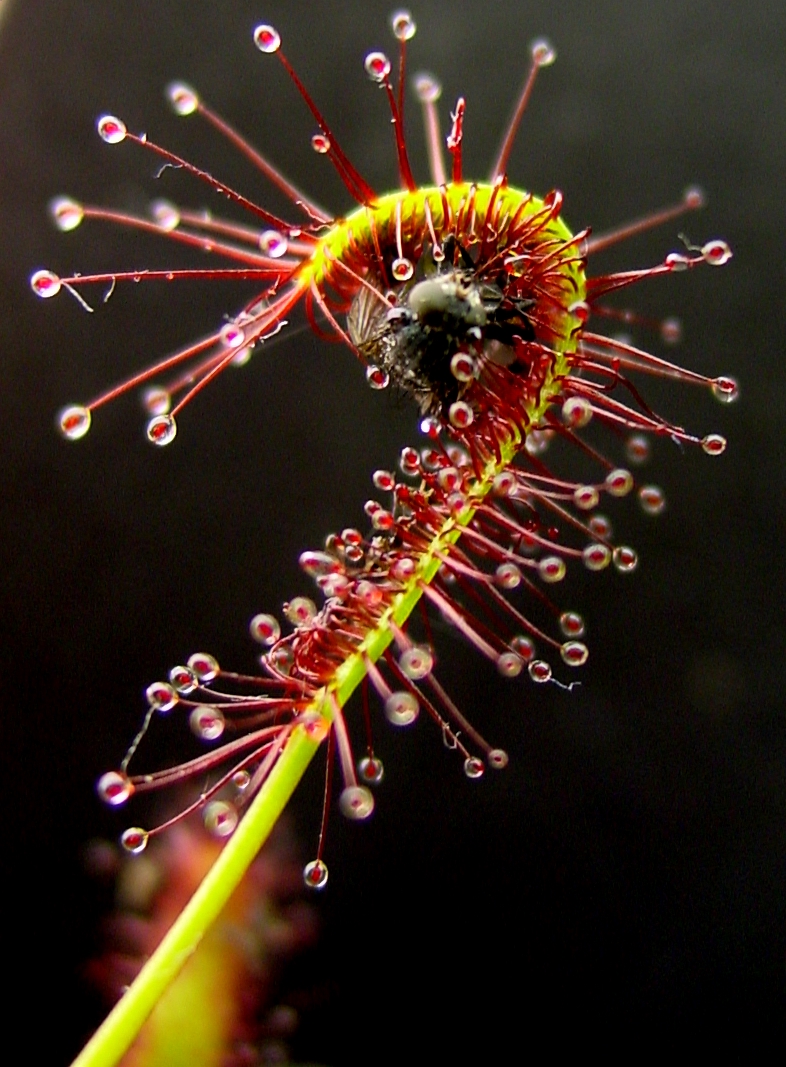
Cape Sundew
Drosera capensis
153 hevitra
panasokajiana
| Family: | Droseraceae |
|---|---|
| karazana: | Drosera |
| mba: | Caryophyllales |
Overview
Drosera capensis is a rosette-forming sundew from the Cape region of South Africa whose long leaves, covered in sticky glands, curl around trapped insects. It is one of the most widely grown and easiest sundews.
Drosera capensis is a perennial herb that forms a rosette typically 4-6 inches (10-15 cm) across, occasionally up to 12 inches (30 cm). Its narrow, oblong leaves are held semi-erect on a distinct petiole, and the remains of old leaves gradually build a short stem, usually about 1.6 inches (4 cm) long but sometimes several inches. The roots are few, thick and up to about 6-8 inches (15-20 cm) long.
The species is variable. Growers recognize several informal forms, including a 'typical' form, narrow-leaved forms, an 'alba' form with white flowers and pale tentacles, and an all-red form. Drosera 'Albino' and Drosera 'Narrow Leaf' have received the Royal Horticultural Society's Award of Garden Merit.
In summer the plant produces one to three flower stalks, usually 6-10 inches (15-25 cm) tall, each with roughly 15-30 flowers that open in sequence from the base. The petals are usually pale purple. The flowers are self-fertile and self-pollinating, and large numbers of tiny seeds ripen four to five weeks after pollination.
D. capensis is tetraploid (2n = 40). A red-leaved form was the first sundew, and the first carnivorous plant of the order Caryophyllales, to have its whole genome sequenced.
Fampahalalana ara-jeografika
Faritra teratany: Western Cape and Eastern Cape, South Africa
Zone toetr'andro: Warm temperate; survives brief frost but not prolonged freezing
Native to the south coast of the Western Cape, from Cape Town north to Gifberg and east into the Eastern Cape as far as Port Elizabeth. It grows from sea level to about 1,800 m (5,900 ft) in permanently wet places such as seeps, creek margins and coastal wetlands, in peaty or sandy soil, on moss-covered rocks, in quartzite rubble or in sphagnum. Although considered a weed in cultivation, it is often uncommon and localized in the wild, becoming numerous where competing plants are cleared, for example after fire. It has become naturalized in several other countries after deliberate introductions.
Toetra ara-batana
Habe matotra: Rosette 4-6 in (10-15 cm) across, up to 12 in (30 cm); flower stalks 6-10 in (15-25 cm)
Taham-pitomboana: Fast
Karazana fandrika: Flypaper Trap
The upper leaf surface is covered in stalked glands (tentacles) that secrete droplets of sticky mucilage containing digestive enzymes. Long tentacles line the margins and shorter ones the center. When an insect touches the marginal tentacles they bend toward the leaf center, bringing it into contact with more glands. The leaf blade itself then slowly bends around the prey, and in D. capensis can roll through more than 180 degrees. The bending is caused by a growth hormone signal (auxin) sent from the leaf tip toward the point of capture. The mucilage is about six times as viscous as water and can be drawn into threads up to about 3 feet (1 m) long.
Torolàlana momba ny fikarakarana
Fitakiana hazavana
Full sun to bright light; it tolerates partial shade but colors best in strong light. It is sturdy enough to have a chance on a bright windowsill, though most subtropical sundews want more light than a windowsill gives, and grow lights work well.
Bright light all year; no seasonal cue needed isan'andro
Fitakiana rano
Type: Rain water, distilled or reverse osmosis water
FOMBA: Keep the soil permanently moist to wet by standing the pot in a saucer or tray of pure water.
hatetika: Keep the tray from drying out; top up as needed
Hamandoana: Moderate to high; above typical indoor levels
nofon-tany
Peat-based mixes such as peat with sand or perlite, the standard peat:sand mix (30-100% peat), or live or long-fiber sphagnum moss. Use silica sand and products with no added fertilizer, and never fertilize the soil.
pH: Acidic (peat or sphagnum based)
hafanana
vanin-taona mafana: 50-95°F (10-35°C)
ririnina: 50-95°F (10-35°C); survives brief light frost
sakafo
hatetika: Occasional small insects or bloodworm pieces when not catching prey
Place small live insects or soaked dried bloodworms on dewy leaves. Feed only plants that have dew, and only with live or wet food. If food goes moldy, use less next time. Do not put fertilizer in the soil.
fampielezana
FOMBA: Seed: the plant self-pollinates and produces hundreds of seeds, which germinate readily on the surface of moist mix; seedlings can flower in their first year. Leaf cuttings laid on moist medium form plantlets. Root cuttings 0.6-1.2 inches (1.5-3 cm) long form new buds in 2-6 weeks. The top of the plant can also be cut off and replanted, and the old roots regrow.
fahasarotana: Easy
Torohevitra ho an'ny vao manomboka
This is one of the best first carnivorous plants. Keep it wet with pure water, give it as much light as you can, and watch a leaf curl around a captured fly.
Fanamboarana
Weak, poorly dewed plants: subtropical sundews want more light and humidity than a typical house provides. Plants declining after years in the same pot: repot or restart from root or leaf cuttings. Seedlings appearing in nearby pots: remove flower stalks before seed ripens if you do not want them.
Torohevitra mitombo
Never plant it outdoors in the wild General
D. capensis has become invasive where it has been planted in natural wetlands, including New Zealand and a California bog. Keep it in pots or garden bog beds.
Easy cuttings Advanced
Short pieces of root, 1.5-3 cm long, laid on moist medium sprout new plants in a few weeks. Whole leaves laid on damp medium also produce plantlets.
Do not let it seed everywhere General
The Cape sundew self-pollinates and produces hundreds of seeds, which sprout in neighboring pots. Cut the flower stalks if you do not want seedlings.
Zava-misy mahaliana
It was one of the five Drosera species in Linnaeus's Species Plantarum of 1753.
Its leaf can roll more than 180 degrees around a captured insect.
Fresh mucilage can be drawn into sticky threads up to about 1 m long.
It was the first sundew to have its genome sequenced (about 264 million base pairs).
It is listed as a pest plant in New Zealand, where it is banned from sale and propagation.
In Albion Bog, Mendocino County, California, planted D. capensis has outcompeted the native sundew D. rotundifolia.
It has no IUCN Red List assessment; the South African national Red List lists it as Least Concern.
Diarin'ny rakitra
D. capensis entered Western botany at the end of the 17th century from specimens gathered at the Cape of Good Hope. Early phrase-name descriptions appeared in John Ray's Historia Plantarum (1704) and in Johannes Burman's Rariorum Africanarum Plantarum (1739), which included a detailed engraving. Carl Linnaeus included it as one of five Drosera species in Species Plantarum (1753). In 1757 John Hill described it in English as the "African Drosera", recommending it as a garden curiosity that could be grown alongside Sarracenia, and it has been cultivated in Europe since the mid-18th century. Carl Thunberg collected it at the Cape between 1772 and 1775. Today it is among the most widely grown sundews and has been studied as a source of bioactive compounds such as the naphthoquinone ramentaceone.
Loharano
Azo vidiana
Karazana karazana mifandraika
Mijanona ho vaovao amin'ny Cape Sundew
Misoratra anarana mba hahazoana toro-hevitra momba ny fikarakarana, torolalana momba ny fitomboana ary fanavaozana manokana Cape Sundew ary zavamaniry mpihinam-bitsika hafa.