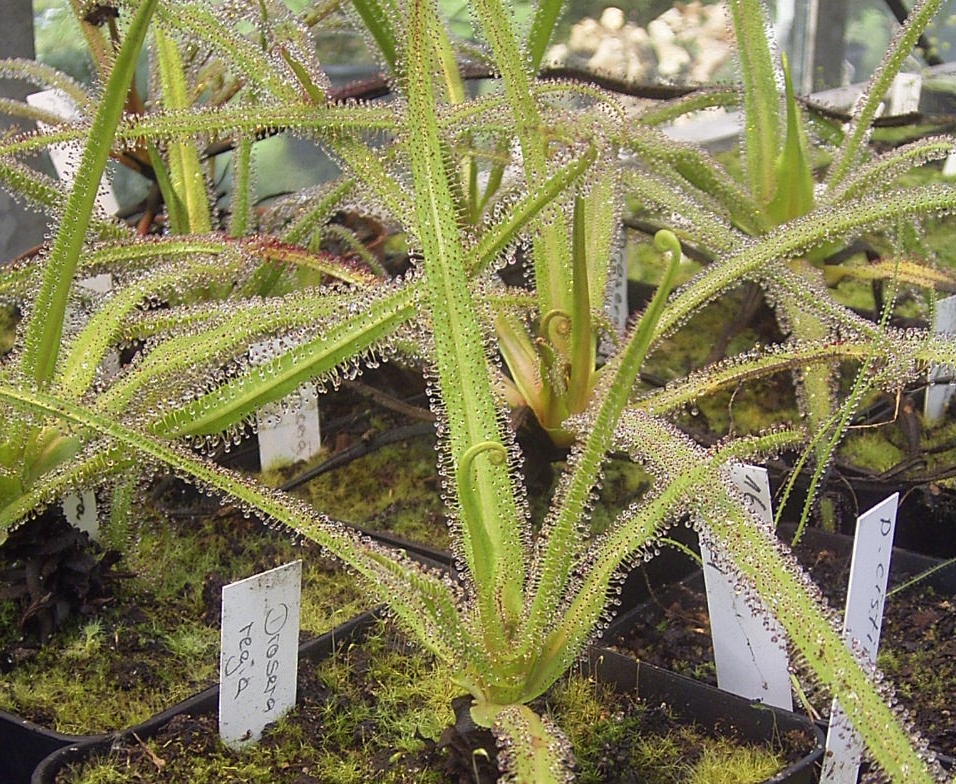
King Sundew
Drosera regia
140 maonero
Taxonomy
| Mhuri: | Droseraceae |
|---|---|
| Genus: | Drosera |
| Order: | Caryophyllales |
Overview
Drosera regia is a large sundew with sword-shaped sticky leaves up to 28 inches (70 cm) long, known in the wild from a single valley in South Africa. It is one of the most ancient lineages in the genus and one of the rarest sundews in the wild.
Drosera regia grows from a horizontal woody rhizome and produces a crown of long, linear leaves up to 70 cm (28 in) long and 2 cm (0.8 in) wide, tapering to a fine point. The leaves have no petiole or stipules and uncurl from a coil as they emerge. Thousands of tentacles cover nearly the whole upper surface. Dead leaves stay attached, clothing the lower stem in blackened remains. The roots are few, thick and fleshy.
It flowers in summer on stalks up to 40 cm (16 in) long, usually a little taller than the leaves, carrying 5 to 20 or more pink flowers up to about 3 cm across. The species is generally self-sterile: pollen is shed before the stigmas of the same flower become receptive, so two flowers open at the same time are needed for seed.
D. regia has several features found in almost no other Drosera, including a woody rhizome, undivided styles, operculate pollen shed in groups of four and a chromosome number of 2n = 34. Molecular studies place it at the base of the genus, close to the Venus flytrap (Dionaea) and the waterwheel plant (Aldrovanda), and it is often regarded as the most ancient living sundew.
Although once considered hard to grow, it is now regarded by experienced growers as a long-lived plant that is easy in cultivation once its needs are understood.
Geographic Information
Native Region: Bainskloof Range near Wellington, Western Cape, South Africa (endemic)
Climate Zones: Mild; USDA 9 and warmer outdoors, protect in zone 8 and colder
D. regia has only ever been found at two sites, at about 500 and 900 m (1,600 and 3,000 ft), in the Bainskloof Range near Wellington in the Western Cape. It grows in fynbos among dense marshy grasses, sedges and restios, in permanently damp, peaty quartzite sand, often with a gravel cover, on hillside seeps where water flows through the soil. The plants grow in full sun but get mild days and cool nights, and frost is infrequent. The habitat depends on periodic fire to stop taller vegetation from choking the plants. By 2006 the higher site appeared overgrown and only about 50 mature plants were recorded at the lower site; after a fire in 2015, a team from Stellenbosch Botanical Garden found new plants at the lower site and rediscovered plants at the upper site.
Hunhu Hwenyama
Kukura Saizi: Leaves up to 28 in (70 cm) long in the wild, often 18 in (45 cm) in cultivation
Chiyero chekukura: Moderate
Trap Type: Flypaper Trap
Stalked glands across the upper leaf surface secrete large droplets of sticky mucilage. Unlike other upright sundews, D. regia can curl its leaves along their whole length as well as moving its tentacles, and leaves may fold over themselves several times around a victim. This lets it hold prey as large as wasps, beetles, moths and butterflies. Leaves can become black with insect remains. Molecular evidence suggests that the snap traps of the Venus flytrap and Aldrovanda evolved from a flypaper trap like that of D. regia.
Care Guide
Chiedza Zvinodiwa
Full sun outdoors or a very bright greenhouse produces the largest leaves. It can be grown as a terrarium plant under lights, but stays smaller and seldom flowers.
Full sun in season; extra light in winter zuva nezuva
Zvinodiwa Mvura
Type: Rain water, distilled or reverse osmosis water
Nzira: Keep wet during the growing season, either standing in a tray in a tall pot or allowing the tray to dry between waterings. The roots need moisture but tolerate stagnant, airless soil worse than most Drosera. Reduce water in winter so the mix stays damp but not soaked.
Frequency: Keep moist in summer; reduce in winter
Humidity: Outdoor or greenhouse humidity is adequate
Ivhu
A light, well-drained mix: loosely packed long-fiber sphagnum, peat with 50% sand or perlite, or about 60% sand to 40% peat.
pH: Acidic (peat based)
Tembiricha
Zhizha: Warm days, cool nights; shield roots from heat
Chando: Cool; light frost near 32°F (0°C) when dormant
Kudyisa
Frequency: Regularly during the growing season
D. regia needs more nutrients than other sundews and declines if it is neither catching plenty of prey nor fed. Feed insects or soaked dried bloodworms on the leaves. The ICPS growing guide notes that, unlike other Drosera, it tolerates and benefits from light soil fertilization with slow-release pellets; this is an exception for this species only, and fertilizer leaking into a shared tray can harm other sundews and flytraps.
Kuparadzira
Nzira: Root cuttings are the easiest method: 2-5 cm pieces of thick root laid on or just under damp peat or sphagnum, kept humid, produce buds in about four weeks. Roots growing out of the drainage holes can be used without disturbing the parent. Seed, from two flowers crossed together, germinates in about 3-5 weeks without pretreatment. Leaf cuttings on soil tend to rot.
Dambudziko: Easy
Beginner Mazano
Give it a big, tall pot, bright sun, pure water and plenty of insects, and keep it cooler in winter. Leave established plants in place rather than repotting often.
Troubleshooting
Slow decline and pale growth: the plant is starving; feed more. Seedlings dying after a few true leaves: often lack of nutrients. Leaves dying back in autumn: normal entry into winter rest. Small plants that never flower: usually too little light.
Kukura Mazano
Expect a winter rest Seasonal
As days shorten, the long leaves die back to a small resting bud. Keep the mix damp, not wet, and the plant cool; new leaves unroll in spring.
A hungry sundew Troubleshooting
Large plants need much more food than other sundews. If yours is pale and shrinking, it is likely starving, so feed it more insects or bloodworms.
Take root cuttings, not leaf cuttings Advanced
Short pieces of the thick roots, laid on damp peat or sphagnum in a humid bag, sprout new plants in about a month. Leaf cuttings usually rot.
Zvinofadza Chokwadi
It is the only species in Drosera subgenus Regiae.
Its woody rhizome is shared within the genus only with D. arcturi.
Its leaves can fold over more than 360 degrees around large prey such as wasps.
It contends for the title of largest sundew, depending on how size is measured.
In 1996 two Czech botanists placed it in its own genus, Freatulina, a split that has not been accepted.
The only registered cultivar, 'Big Easy' (2004), is compact, with leaves to about 9 in (23 cm).
It has not been assessed under current IUCN criteria; the ICPS lists it among imperiled carnivorous plants.
History
D. regia was described in 1926 by the South African botanist Edith Layard Stephens. She had learned of it from J. Rennie, who found plants by a stream at the upper end of Baviaans Kloof at Easter 1923. The epithet regia means "royal", for what Stephens called its striking appearance, and she reported cultivating it successfully in a moist, cool atmosphere.
Its unusual features made its classification debated. Anna Amelia Obermeyer noted in 1970 that it fit none of the existing groups; in 1994 Rüdiger Seine and Wilhelm Barthlott placed it alone in a new subgenus, Regiae, an arrangement affirmed by Jan Schlauer in 1996. In 2004 William Joseph Clemens registered the cultivar 'Big Easy' in Carnivorous Plant Newsletter.
Zvimwe
Inowanikwa Kutenga
Related Species
Stay Updated on King Sundew
Nyorera kuti ugamuchire matipi ekuchengeta, madhairekitori ekukura, uye zvigadziriso zvakanangana nazvo King Sundew nezvimwe zvinodya nyama.