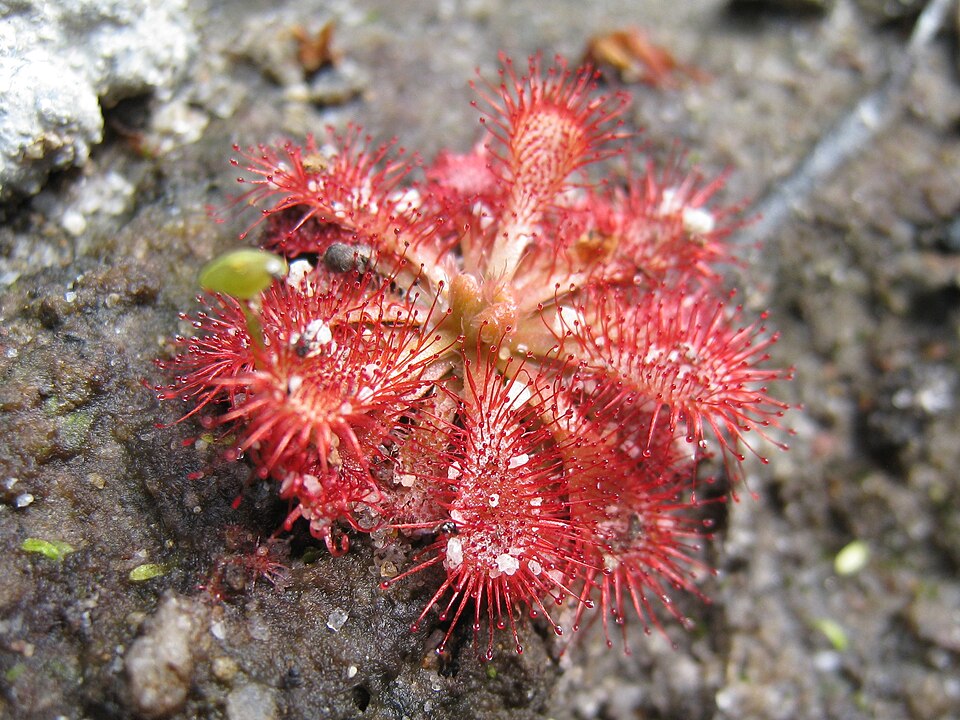
Spoon-Leaved Sundew
Drosera spatulata
144 skoðanir
Flokkunarfræði
| Fjölskylda: | Droseraceae |
|---|---|
| Ættkvísl: | Drosera |
| Pöntun: | Caryophyllales |
| Undirtegund: | var. spatulata, var. gympiensis (2005) and var. bakoensis (2009) |
Yfirlit
Drosera spatulata is a small, variable sundew that forms flat rosettes of spoon-shaped, sticky leaves. It has a very large range, from East and Southeast Asia to Australia and New Zealand.
Drosera spatulata is a perennial that forms a small rosette of many spoon-shaped (spathulate) leaves, generally about 1.6 inches (4 cm) across. Each leaf has a narrow petiole about 8 mm long, glandular only on its upper half, and a blade typically about 5 mm long and 4 mm wide. The name spatulata is Latin for "spatula shaped".
In early summer it produces upright flower stalks about 3 inches (8 cm) tall, each carrying around six small white or pink flowers on one side of the stalk; each flower is up to about 6 mm across.
The species is highly variable, and growers often label plants by the locality they came from. Three varieties are recognized, and registered cultivars include Drosera 'Kanto', the very dark red 'Ruby Slippers' and the large 'Tamlin'.
Because it is hardy and flowers freely, producing large amounts of seed that germinates easily, carnivorous plant growers often regard it as a weed that appears in neighboring pots.
Landfræðilegar upplýsingar
Upprunalegt svæði: Southeast Asia, southern China, Japan, Micronesia, New Guinea, eastern Australia, Tasmania, New Zealand
Loftslagssvæði: Subtropical to warm temperate
D. spatulata occurs naturally throughout Southeast Asia, southern China and Japan, Micronesia, Papua New Guinea, eastern Australia, Tasmania and New Zealand. In New South Wales it grows in wetlands and heath and is especially widespread in coastal areas, and it is also recorded from Queensland, Victoria and Tasmania. Var. bakoensis was described from Bako National Park in Sarawak, Borneo. The plant does not form winter resting buds (hibernacula).
Líkamleg einkenni
Stærð fullorðinna: Rosette about 1.6 in (4 cm) across; flower stalks about 3 in (8 cm)
Vaxtarhraði: Moderate
Tegund gildru: Flypaper Trap
Like other sundews, the leaf blades are covered with stalked glands whose glistening drops of sticky mucilage attract and hold small insects. Trapped prey is held by the mucilage, which can clog its breathing pores, and the stalked glands secrete enzymes to digest it while sessile glands absorb the resulting nutrients. The tentacles bend toward captured prey.
Umhirðuleiðbeiningar
Kröfur um ljós
Bright light. Subtropical sundews want more light than a typical windowsill provides; grow lights or a bright terrarium or greenhouse give the best color and dew.
Bright light all year; no seasonal cue needed daglega
Vatnskröfur
Tegund: Rain water, distilled or reverse osmosis water
Aðferð: Keep the pot standing in a shallow tray of pure water so the soil stays wet.
Tíðni: Keep the tray from drying out; top up as needed
Rakastig: Moderate to high; above typical indoor levels
Jarðvegur
Peat:sand mix (30-100% peat) or live or long-fiber sphagnum moss. Choose silica sand and products without added fertilizer. Never fertilize the soil.
pH: Acidic (peat or sphagnum based)
Hitastig
Sumar: 50-95°F (10-35°C)
Vetur: 50-95°F (10-35°C); no hibernacula formed
Fóðrun
Tíðni: Occasional tiny insects or bloodworm fragments if not catching prey
The plant catches small flies on its own. Indoors, a speck of soaked dried bloodworm on a dewy leaf is enough; feed only dewy plants and only with live or wet food.
Fjölgun
Aðferðir: Seed, produced copiously and germinating easily when sown on the surface of moist mix; leaf and root cuttings.
Erfiðleikar: Easy
Ráðleggingar fyrir byrjendur
A tough, small sundew that suits a bright terrarium or a sunny tray of pots. Keep it wet with pure water and in strong light.
Úrræðaleit
Weak plants: subtropical sundews want more light and humidity than a typical house provides. Unwanted seedlings in other pots: remove flower stalks before the seed ripens.
Ráðleggingar um ræktun
Keep the seed in check Troubleshooting
It flowers freely and its seed germinates easily, so seedlings pop up in neighboring pots. Cut flower stalks if you want to keep cultivars and other sundews pure.
Grow it like a Cape sundew General
D. spatulata takes the same conditions as Drosera capensis: wet peat or sphagnum, pure water, bright light and no winter dormancy.
Áhugaverðar staðreyndir
Growers often call it a weed because its seed sprouts readily in neighboring pots.
The common misspelling 'spathulata' dates from an 1824 printing error by Augustin Pyramus de Candolle.
Drosera tokaiensis arose in the wild from a hybrid of D. rotundifolia and D. spatulata that became fertile through chromosome doubling.
Var. gympiensis is distinguished by its consistently hairy sepals.
Unlike temperate sundews it does not form hibernacula in winter.
Ferill
Jacques Labillardière first described Drosera spatulata in 1804 in Novae Hollandiae Plantarum Specimen, from a specimen found in Tasmania. In 1824 Augustin Pyramus de Candolle included it in a publication but misprinted the name as Drosera spathulata, a spelling that is still common. The species has been described under several other names since, now treated as synonyms, including D. loureirii, D. lovellae and D. propinqua. In 2005 Robert Gibson and Ivan Snyder described var. gympiensis, and in 2009 var. bakoensis was described from Bako National Park in Borneo.
Heimildir
Fáanlegt til kaups
Tengdar tegundir
Vertu uppfærður á Spoon-Leaved Sundew
Gerast áskrifandi til að fá ráðleggingar um umhirðu, leiðbeiningar um ræktun og uppfærslur sem eru sértækar fyrir Spoon-Leaved Sundew og aðrar kjötætur plöntur.