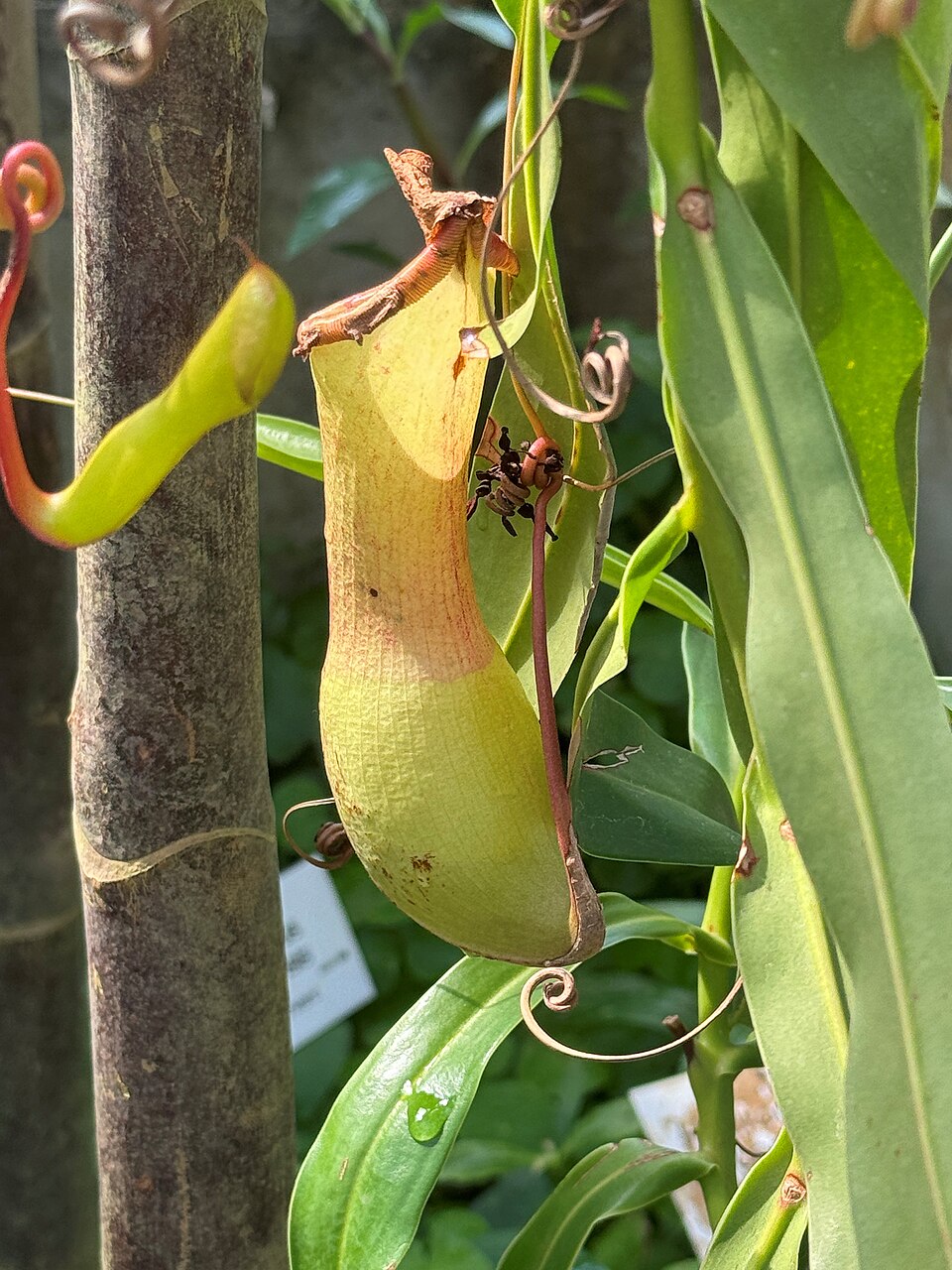
Tropical Pitcher Plant (Monkey Cup)
Nepenthes ventricosa
146 ogledi
Taksonomija
| Družina: | Nepenthaceae |
|---|---|
| Rod: | Nepenthes |
| Naročilo: | Caryophyllales |
Pregled
Nepenthes ventricosa is a tropical pitcher plant endemic to the Philippines, where it grows in the highlands at 1,000-2,000 m. It produces numerous waxy, waisted pitchers up to about 8 inches (20 cm) tall in colors from ivory white to red.
Nepenthes ventricosa is a highland species of tropical pitcher plant. Like other Nepenthes it grows as a climbing or scrambling plant: an extension of each leaf's midrib forms a tendril, and the pitcher develops at the tendril's tip. Lower pitchers form on young plants, while mature, climbing plants produce upper (aerial) pitchers that often differ in shape and color.
The pitchers of N. ventricosa are numerous, glossy and waxy, with a narrowed 'waist' in the middle, and range from ivory white through green and speckled forms to red. The species name comes from Neo-Latin ventricosus, "having a swelling on one side". It is very closely related to N. burkei and N. sibuyanensis, but differs from them in its more waisted pitchers, smaller mouth and, generally, thinner peristome. Many plants labeled N. burkei in collections are reported to be N. ventricosa.
Nepenthes plants are either male or female, so seed can only be produced when plants of both sexes flower at the same time. Like all Nepenthes, the species hybridizes readily; in the wild it crosses with N. alata to form the natural hybrid N. × ventrata.
Geografske informacije
Domača regija: Philippines (endemic); recorded from Luzon, Panay and Sibuyan
Podnebne cone: Tropical highland (1,000-2,000 m); grown under glass outside the tropics
A highland species of the Philippines, growing at elevations of about 1,000-2,000 m (3,300-6,600 ft). It has been recorded on the islands of Luzon, Panay and Sibuyan; one photographed habitat is on Mayon Volcano in Luzon.
Fizične lastnosti
Velikost za odrasle: Pitchers up to 8 in (20 cm) tall; stems climb and lengthen with age
Stopnja rasti: Moderate
Vrsta pasti: Pitfall Trap
Each pitcher is a modified leaf tip that holds digestive fluid. Insects, chiefly ants and other arthropods, are attracted by color, nectar and scent. The ridged rim around the mouth, the peristome, is slippery, especially when wet, and insects that step onto it can 'aquaplane' and fall in. A waxy coating on the upper inner wall makes climbing out nearly impossible. Glands in the lower part of the pitcher secrete digestive enzymes and absorb the released nutrients. A lid (operculum) above the mouth helps keep rain from diluting the fluid. The fluid also contains antimicrobial compounds that limit the growth of bacteria and fungi.
Vodnik za nego
Zahteve glede svetlobe
Bright, diffuse light. Unlike most carnivorous plants, Nepenthes do not need full, intense sun; a very bright window or a brightly lit terrarium or greenhouse works, and artificial light can be enough if it is bright.
Bright light year round; no seasonal rest dnevno
Zahteve glede vode
Vrsta: Purified water (distilled, reverse osmosis or rain) is safest
Metoda: Water from above to keep the mix evenly moist, and let excess drain. Do not keep the pot standing in water: for most species this dwarfs the root system and the whole plant.
Pogostost: Often enough to keep the mix moist, as often as every day or so
Vlažnost: High: at least 60%, ideally near 90%
Tla
A 50:50 mix of long-fiber sphagnum moss and perlite is a good general starting point. Growers also use pure sphagnum or sphagnum with other coarse aggregates. Check the roots after a year and change the mix if they are not spreading through it.
pH: Acidic (sphagnum based)
Temperatura
Poletje: Days 77-86°F (25-30°C), nights about 18°F cooler
Zima: Same as summer; keep above frost all year
Hranjenje
Pogostost: Optional; any fertilizer at most once or twice a month into pitchers
Plants in a greenhouse or outdoors catch insects on their own. Some growers pour a small amount of orchid or epiphyte fertilizer into the pitchers once or twice a month, starting small and watching the effect; it is optional, and many growers do not fertilize at all.
Razmnoževanje
Metode: Stem cuttings: cut green stems into segments with about two leaves each, trim the leaves to about a third of their size, set the lower half in the medium and keep the cutting in very high humidity. Roots usually form within about a month. Seed needs a male and a female plant flowering at the same time; it is short-lived and should be sown immediately.
Težavnost: Moderate
Nasveti za začetnike
Start with a small plant that fits in a terrarium or very humid spot. Keep it warm and humid, water from the top, and accept that old pitchers die off naturally as new ones form.
Odpravljanje težav
New leaves without pitchers: a general sign that conditions are not good enough, most often too little humidity or light. Leaf edges burning and tendrils failing to form pitchers: humidity too low. Small plant with a weak root system: the pot has been standing in water.
Nasveti za gojenje
Give it cool nights Advanced
As a highland species, N. ventricosa grows best with days around 77-86°F (25-30°C) and nights about 18°F (10°C) cooler.
Do not leave it standing in water General
Unlike Venus flytraps and Sarracenia, Nepenthes should be watered from above and allowed to drain. Constantly standing in a tray stunts the roots.
Humidity makes the pitchers Troubleshooting
If new leaves stop producing pitchers, raise the humidity first. Nepenthes want at least 60% relative humidity, and closer to 90% is better.
Zanimiva dejstva
The name ventricosa means 'having a swelling on one side', describing the pitcher's bulging shape.
It forms a natural hybrid with N. alata, named N. × ventrata.
Pitcher color ranges from almost ghostly white or cream to green, speckled and red.
Nepenthes plants are either male or female.
Larvae of the Asian tiger mosquito have been recorded living in pitchers of N. ventricosa grown in Virginia (Duffield and Sheridan, 2007).
The IUCN Red List assessed the species as Least Concern in 2018 (Clarke, assessment T39710A143966192).
Zgodovina
Nepenthes ventricosa was described by Francisco Manuel Blanco in 1837, in his Flora de Filipinas. Botanical knowledge of the genus had begun much earlier: in 1790 the Portuguese priest João de Loureiro described a pitcher plant from Vietnam as Phyllamphora mirabilis, mistakenly stating that its lid opened and closed on its own. Today about 170 Nepenthes species are recognized, with new ones described almost every year.
Viri
- Nepenthes ventricosa, Wikipedia
- Nepenthes, Wikipedia
- Nepenthes: species of the Philippines, The Carnivorous Plant FAQ (Barry Rice)
- Nepenthes: basic cultivation, The Carnivorous Plant FAQ (Barry Rice)
- Nepenthes: advanced cultivation, The Carnivorous Plant FAQ (Barry Rice)
- Thumbnail guidelines on growing a tropical pitcher plant, The Carnivorous Plant FAQ (Barry Rice)
Na voljo za nakup
Bodite na tekočem Tropical Pitcher Plant (Monkey Cup)
Naročite se na prejemanje nasvetov za nego, vodnikov za gojenje in posodobitev, specifičnih za Tropical Pitcher Plant (Monkey Cup) in druge mesojede rastline.