Mexican Butterwort
Pinguicula moranensis
85 ra'ayoyi
Taxonomy
| Iyali: | Lentibulariaceae |
|---|---|
| Halitta: | Pinguicula |
| Oda: | Lamiales |
| Nau'o'i: | var. moranensis and var. neovolcanica (Zamudio 1999) |
Dubawa
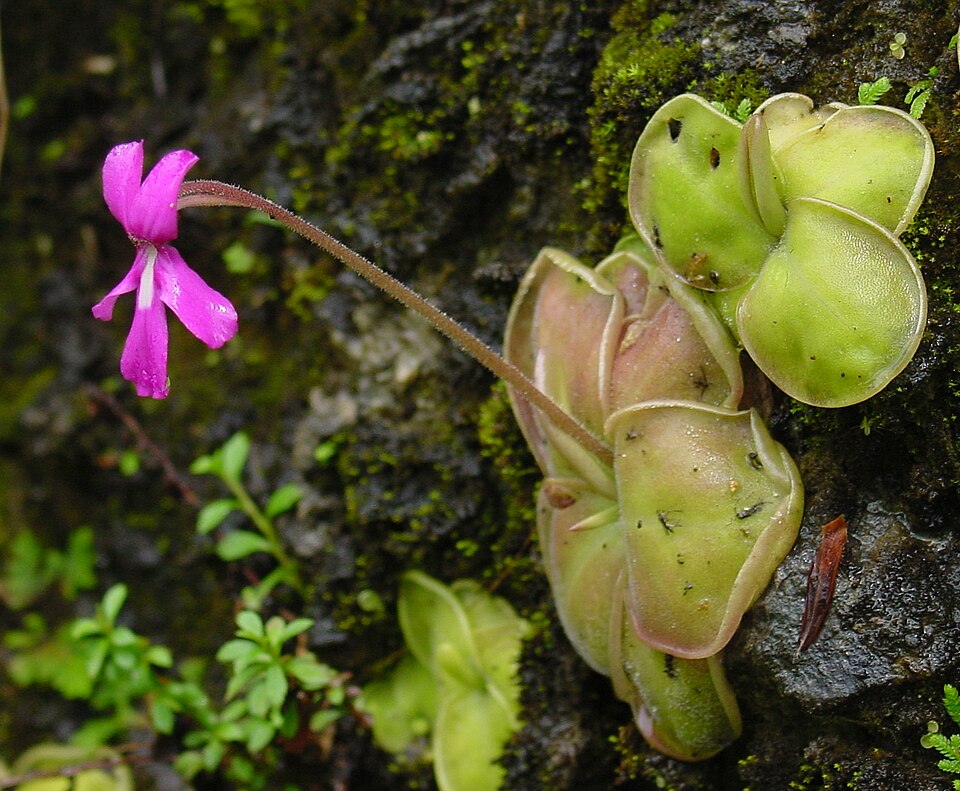
Pinguicula moranensis is a Mexican and Central American butterwort that forms flat summer rosettes of sticky, insect-trapping leaves and small succulent rosettes in winter. It is the most widespread Pinguicula in Mexico and one of the most commonly grown butterworts.
Pinguicula moranensis is seasonally dimorphic. During the rainy summer it forms a ground-hugging rosette of 6-8 flat, succulent, obovate leaves up to about 4 inches (10 cm) long, ranging from yellow-green to maroon. These leaves are carnivorous. With the onset of the dry season in October they are replaced by a compact winter rosette, 2-3 cm (about 1 in) across, of 60 to 100 or more small, fleshy, hairy, non-carnivorous leaves, which the plant keeps until rains return around May.
Unusually among Mexican butterworts, it flowers twice a year, from both the summer and the winter rosette. Single flowers, 3-5 cm long with a backward-pointing spur, are borne on stalks 10-25 cm (4-10 in) tall. They are typically pink to purple, often with a white throat, and extremely variable in color; a rare white form exists.
The species is taxonomically difficult because of its variability and large range, and many names have been reduced to its synonyms. Two varieties are recognized: var. moranensis, with open winter rosettes, generally on limestone, and var. neovolcanica, with closed, bulb-like winter rosettes, on volcanic rock.
No natural hybrids are known, but it crosses readily in cultivation and is a parent of many registered cultivars.
Bayanan Geographic
Yankin Ƙasa: Mexico, Guatemala, El Salvador and Honduras
Yankunan Yanayi: Subtropical highland, with wet summers and dry winters
P. moranensis is the most common and widely distributed butterwort in Mexico, found in all major mountain ranges except the Sierra Madre Occidental and Baja California, and also in Guatemala, El Salvador and Honduras. It grows at 800-3,200 m (2,600-10,500 ft), most often in oak, pine-oak or temperate montane woodland, extending into tropical forest and dry shrubland. It favors humid, shady places: stream banks, gullies, road cuts, canyon walls and leaf litter in sandy soil. Its roots serve mainly as anchorage, so it can also grow on boulders, moss-covered rock faces and even tree trunks. The typical variety tends to grow on Cretaceous sedimentary (limestone) outcrops, while var. neovolcanica grows on volcanic rocks of the Trans-Mexican Volcanic Belt.
Halayen Jiki
Balagagge Girma: Summer rosette leaves to 4 in (10 cm); flower stalks 4-10 in (10-25 cm)
Yawan Girma: Moderate
Nau'in tarko: Flypaper Trap
The upper surface of each summer leaf is densely covered with two kinds of glands. Stalked glands secrete droplets of mucilage that give the leaf a wet, buttery look and may lure insects seeking water. When an insect lands, it sticks, and its struggling triggers more glands to release mucilage until it is coated. The leaf edges can curl slightly to bring more glands into contact. Flat (sessile) glands then release digestive enzymes, including amylase, esterase, phosphatase, protease and ribonuclease, and the dissolved nutrients are absorbed through small openings in the leaf cuticle, leaving only the exoskeleton. Small flies are the most common prey. The flower stalks are also glandular and catch insects.
Jagoran Kulawa
Bukatun Haske
Bright light with moderate sun: a bright, sunny window or grow lights. The plant needs the natural seasonal change in day length to switch between its summer and winter rosettes; on a constant light period it tends to stay stuck in the non-carnivorous phase.
Seasonal day length, natural or on a timer kullum
Bukatun Ruwa
Nau'in: Distilled, reverse osmosis or rain water
Hanya: This is not a bog plant. In summer, stand the pot in up to about 0.8 inch (2 cm) of water, and do not worry if the tray dries for a few days. In the winter succulent phase, let the tray dry out for a week or so between waterings, or water only very rarely.
Yawanci: Regular in summer; sparse in winter
Danshi: Moderate; household humidity is usually fine
Ƙasa
An open, well-drained mix. A good indoor mix is equal parts peat, coarse sand and perlite, with about a tablespoon of dolomitic lime per cup of mix to offset the peat's acidity. Pumice can replace perlite. Greenhouse growers often use pure mineral mixes; vermiculite and vermiculite:perlite mixes are also used. Top with coarse sand to discourage fungus gnats.
pH: Neutral to alkaline preferred
Zazzabi
Lokacin bazara: Warm, humid; ordinary room temperature suits it
Winter: Cooler and drier than summer; no frost
Ciyarwa
Yawanci: Not usually needed; plants trap fungus gnats and small flies
Plants catch small flies and fungus gnats on their own. Mexican butterworts appreciate light fertilization, best as a dilute orchid or epiphyte fertilizer sprayed on the leaves; avoid acid-based fertilizers, and take care in water trays, where it is easy to overdo.
Yadawa
Hanyoyin: Leaf pullings are the standard method; the succulent winter leaves work especially well, and winter is the best time to propagate and repot. Seed needs cross-pollination by hand, since the flower's stigma covers the anthers; sow on the surface at 60-80°F (15-25°C), where it germinates in 4-8 weeks.
Wahala: Easy
Tukwici Na Farko
Treat it more like a succulent houseplant than a bog plant: an open mix, bright light, regular water in summer and very little in winter. If you can grow African violets, you can grow this.
Shirya matsala
Plant stays in small non-sticky leaves all year: it lacks a seasonal change in day length. Leaves rotting in winter: the mix is too wet during the succulent phase. Salt crust on the soil: repot and check the water source.
Tips girma
Propagate from winter leaves Advanced
Gently pull a few of the succulent winter leaves and lay them on a moist mix. Each can form a new plant.
Never use fungicide Troubleshooting
Fungicides, even cinnamon, are reported to kill Pinguicula. Prevent rot by keeping the mix open and fairly dry in winter instead.
Respect the winter rest Seasonal
When the plant shrinks into a tight rosette of small succulent leaves in autumn, cut watering right back until it resumes carnivorous growth in spring.
Abubuwa Masu Ban sha'awa
The genus name Pinguicula comes from Latin pinguis, 'fat', for the buttery feel of the leaves.
Its winter rosette is so tight that it looks more like a Sempervivum than a carnivorous plant.
It flowers twice a year, once from each type of rosette.
Plants growing where prey is scarce produce more capture glands; where prey is plentiful, more digestive glands.
Mexican butterworts are mostly pollinated by hummingbirds.
Its chromosome count is 2n = 44.
History
Alexander von Humboldt and Aimé Bonpland collected the species near Mina de Morán in the Sierra de Pachuca, in the modern state of Hidalgo, during their 1799-1804 expedition. Carl Sigismund Kunth described it in 1817 in Nova Genera et Species Plantarum, making it one of the first Mexican butterworts known to science; the epithet refers to the type locality. William Hemsley later lumped the Mexican species of section Orcheosanthus together under the name P. caudata, a name still applied loosely to this plant. S. J. Casper's 1966 monograph treated P. caudata as a synonym of P. moranensis. In 1999 Sergio Zamudio, after locating the original limestone population, separated var. neovolcanica, and a 2005 molecular study by Cieslak and colleagues suggested placing the species in section Longitubus. It has long been cultivated for its carnivory and attractive flowers.
Sources
Akwai don Siyayya
Nau'o'i masu alaƙa
Ci gaba da sabuntawa Mexican Butterwort
Biyan kuɗi don karɓar shawarwarin kulawa, jagorar girma, da sabbin abubuwa na musamman Mexican Butterwort da sauran tsire-tsire masu cin nama.