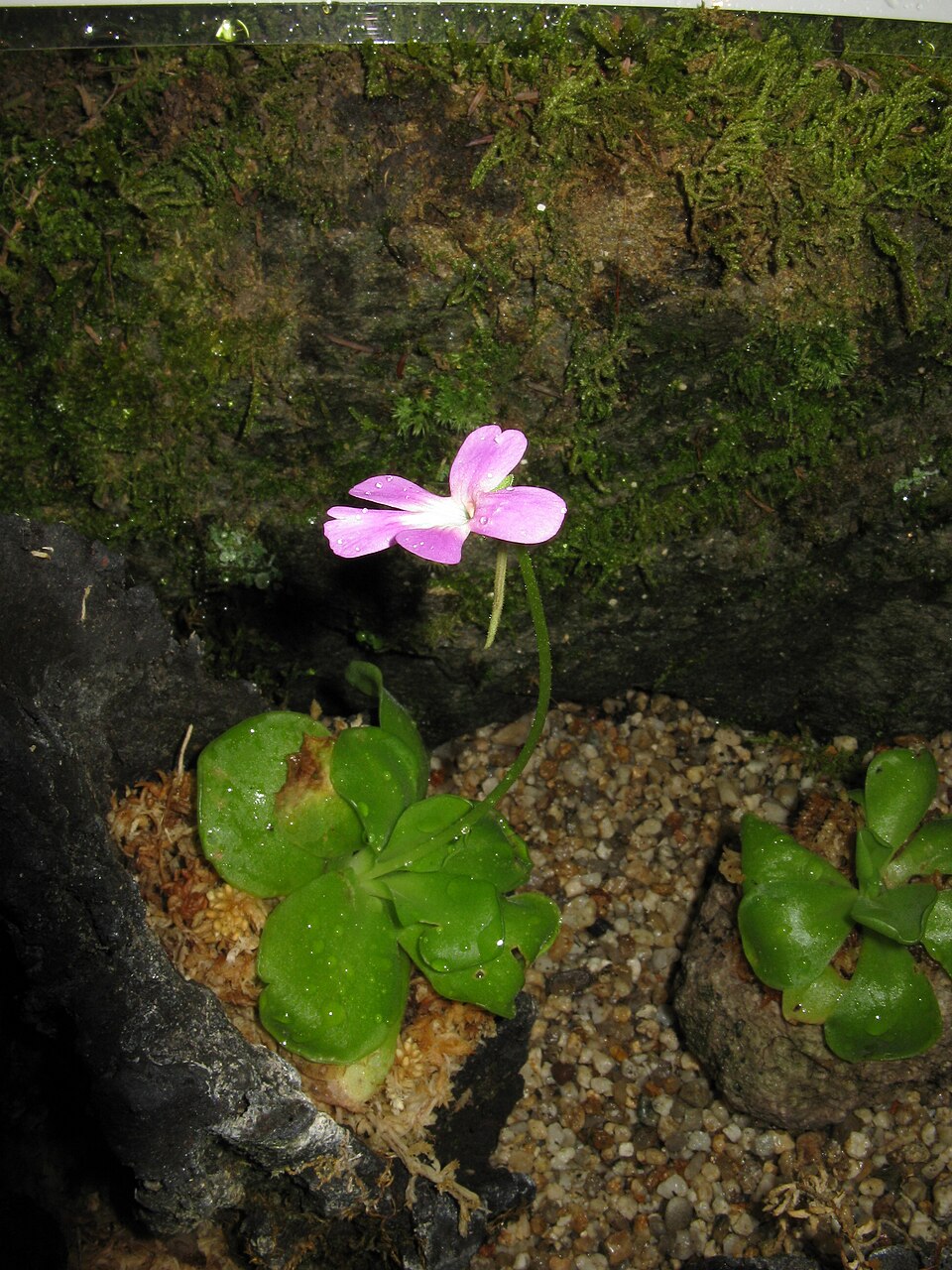
Butterwort 'Sethos'
Pinguicula 'Sethos'
55 seallaidhean
Tacsonamaidh
| Teaghlach: | Lentibulariaceae |
|---|---|
| Gnè: | Pinguicula |
| Òrdugh: | Lamiales |
Sealladh farsaing
Pinguicula 'Sethos' is a cultivated hybrid butterwort, P. ehlersiae × P. moranensis, raised in Germany around 1981. It is known for its many large orchid-purple flowers with a white, star-like center.
Pinguicula 'Sethos' is a horticultural hybrid between two Mexican butterworts, Pinguicula ehlersiae and Pinguicula moranensis. It does not occur in the wild; the name applies to a single clone.
Adrian Slack described it as a fine, very floriferous clone with large orchid-purple flowers whose mouth is marked like a many-rayed white star. Another clone of the same parentage, 'Weser', has rather similar flowers but with a single white streak down the central lower lobe and dark veins.
Like both parents, it is a Mexican-type butterwort: carnivorous, sticky leaves in the growing season, and a rest in a rosette of small, non-carnivorous leaves in winter. Hybrids of Mexican butterworts are often vigorous and more forgiving in cultivation than pure species, and they often bloom over a longer period.
Fiosrachadh Cruinn-eòlasach
Roinn Dhùthchasach: Cultivated hybrid; parents native to Mexico and Central America
Sònaichean Gnàth-shìde: Indoor or greenhouse; parents from subtropical Mexican highlands
As a garden hybrid, 'Sethos' has no natural habitat. Its parent P. ehlersiae is native to the Mexican states of Hidalgo and San Luis Potosí, while P. moranensis ranges across most Mexican mountain ranges into Guatemala, El Salvador and Honduras, growing in humid, often shady montane woodland, on rock faces and on limestone. Many Mexican butterworts grow in seasonal fog forests on limestone cliffs and tree trunks, with a wet summer and a dry winter.
Feartan Corporra
Meud Inbheach: Not recorded for the cultivar; P. moranensis leaves reach 4 in (10 cm)
Ìre Fàis: Moderate
Seòrsa Ribe: Flypaper Trap
As in all butterworts, the upper surface of the carnivorous leaves carries stalked glands that secrete sticky mucilage and flat glands that release digestive enzymes. Small insects such as gnats and flies stick to the leaf, more mucilage is released as they struggle, and the dissolved nutrients are absorbed through the leaf surface, leaving only the exoskeleton.
Stiùireadh Cùraim
Riatanasan Solais
Bright light, such as a bright, sunny window or grow lights. Like other Mexican butterworts it needs a gradual seasonal change in day length to switch between summer and winter growth.
Seasonal day length, natural or on a timer làitheil
Riatanasan Uisge
Seòrsa: Distilled, reverse osmosis or rain water
Modh: Not a bog plant. In the carnivorous phase, stand the pot in up to about 0.8 inch (2 cm) of water and let the tray dry for a few days now and then. In the winter succulent phase, let the tray stay dry for a week or so between waterings.
Tricead: Regular in summer; sparse in winter
Taiseachd: Moderate; household humidity is usually fine
Ùir
An open, mineral-rich mix: equal parts peat, coarse sand and perlite with dolomitic lime added, or a vermiculite:perlite or mostly mineral mix for humid greenhouses. Mexican butterworts generally prefer a neutral to alkaline mix.
pH: Neutral to alkaline preferred
Teòthachd
Samhradh: Warm, humid; ordinary room temperature suits it
Geamhradh: Cooler and drier than summer; no frost
A' biathadh
Tricead: Not usually needed; plants catch gnats and small flies
Plants catch fungus gnats and small flies. Light feeding with a dilute orchid or epiphyte fertilizer sprayed on the leaves is optional; avoid acid-based fertilizers.
Iomadachadh
Modhan: Leaf pullings, ideally of the succulent winter leaves, which reproduce the clone. Seed from a hybrid clone does not reproduce that clone.
Duilgheadas: Easy
Molaidhean airson Luchd-tòiseachaidh
A forgiving, free-flowering butterwort for a bright windowsill. Use an open mix and pure water, and cut back watering when the winter rosette forms.
Fuasgladh dhuilgheadasan
No sticky summer leaves: the plant probably lacks a seasonal change in day length. Rot in winter: water less during the succulent phase.
Molaidhean airson Fàs
Water less in winter Seasonal
When the plant forms its small winter rosette, let the tray dry out for about a week between waterings until carnivorous leaves return in spring.
Keep the clone true General
Propagate 'Sethos' from leaf pullings, not seed. Seedlings from a hybrid will vary and should not carry the cultivar name.
Fiosrachadh Inntinneach
Parentage: Pinguicula ehlersiae × Pinguicula moranensis.
It was raised by H. Weiner in Hameln, Germany, in 1981.
The origin of the name is obscure; the ICPS register suggests it may allude to a Pharaoh.
'Weser', of the same parentage, was described alongside it in Slack's 1986 book.
The same cross of P. moranensis and P. ehlersiae is part of the complex hybrid P. 'Pirouette'.
The ICPS register description of the hybrid P. 'Bailly' compares its rosette and paler pink flower to 'Sethos'.
Eachdraidh
The hybrid was raised by H. Weiner at Hameln, Germany, in 1981. The name 'Sethos' (Hort. Slack) was published by the grower Adrian Slack in his 1986 book Insect-Eating Plants and How to Grow Them, page 113, together with its sister clone 'Weser'. Slack registered the name with the International Carnivorous Plant Society on 10 November 1998.
Taighean-seallaidh
- Pinguicula cultivar register, Carnivorous Plant Names resource, International Carnivorous Plant Society
- Pinguicula hybrids, The Carnivorous Plant FAQ (Barry Rice)
- Heterophyllous Pinguicula of Mexico and Central America, The Carnivorous Plant FAQ (Barry Rice)
- Pinguicula moranensis, Wikipedia
- Growing Mexican Pinguicula, International Carnivorous Plant Society
- Pinguicula cultivation, The Carnivorous Plant FAQ (Barry Rice)
Ri fhaighinn airson a cheannach
Gnèithean co-cheangailte
Fuirich suas ris an fhiosrachadh as ùire Butterwort 'Sethos'
Fo-sgrìobh gus molaidhean cùraim, stiùiridhean fàis agus ùrachaidhean sònraichte fhaighinn Butterwort 'Sethos' agus lusan feòil-itheach eile.