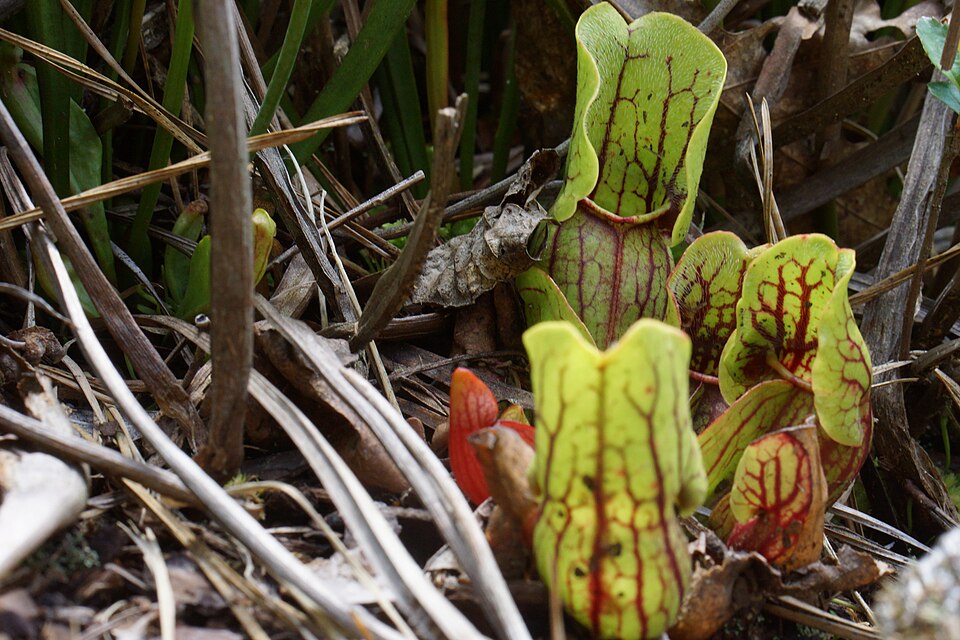
Purple Pitcher Plant
Sarracenia purpurea
3 views
Taxonomy
| Family: | Sarraceniaceae |
|---|---|
| Genus: | Sarracenia |
| Order: | Ericales |
| Subspecies: | subsp. purpurea (northern) and subsp. venosa (southern) |
Overview
Sarracenia purpurea is a low-growing North American pitcher plant whose squat, rain-filled pitchers trap insects. It has the widest range of any Sarracenia and is the only member of the genus that grows in cold temperate climates.
Sarracenia purpurea, also called the northern pitcher plant, turtle socks or side-saddle flower, forms a rosette of curved, squat pitchers up to about 12 inches (30 cm) long. Unlike the tall trumpet pitchers of other Sarracenia, its hood stands upright and does not shield the mouth, so the pitchers fill with rainwater. The hood is often veined in red and is covered with stiff hairs pointing toward the opening. Individual pitchers can last for two years, longer than in most other Sarracenia.
Two subspecies are generally recognized. Subsp. purpurea grows in the north, mostly in areas that were glaciated, and has smooth, glossy pitchers and darker red to purple flowers. Subsp. venosa grows to the south, from New Jersey to Georgia, and has rougher, hairy pitchers. Intermediate plants occur where the two meet, from New Jersey toward Virginia. Gulf Coast plants once treated as S. purpurea are now usually separated as Sarracenia rosea.
The flowers, borne in spring on separate stalks, are purplish red; an anthocyanin-free form of the northern subspecies, f. heterophylla, has bright green leaves and yellow flowers.
The species is cultivated as an ornamental, and subsp. purpurea has received the Royal Horticultural Society's Award of Garden Merit. It is the floral emblem of the Canadian province of Newfoundland and Labrador.
Geographic Information
Native Region: Eastern North America: Atlantic seaboard, Great Lakes and most of Canada; introduced in Europe
Climate Zones: Cold temperate; subsp. purpurea grows outdoors in USDA 5 and colder
Sarracenia purpurea grows in nutrient-poor, acid bogs and fens. Its range covers the eastern seaboard of the United States, the Great Lakes region and every Canadian province and territory except Nunavut and Yukon, making it the most widely distributed pitcher plant. Within that range it occurs in isolated patches, and it is endangered or vulnerable over much of the southern part of its range. Mountain populations occur in North Carolina, Georgia and South Carolina. Introduced, naturalized populations exist in the western United States and in several European countries, including Ireland and the United Kingdom.
Physical Characteristics
Mature Size: Pitchers up to 12 in (30 cm) long, held low in a rosette
Growth Rate: Moderate
Trap Type: Pitfall Trap
Insects such as flies, ants, spiders, moths and hornets are guided by the downward-pointing hairs of the hood and fall into the rainwater collected in the pitcher, where they drown. New pitchers produce their own digestive enzymes. As pitchers age, digestion relies increasingly on a community of organisms living in the fluid, including larvae of the pitcher plant mosquito Wyeomyia smithii and the midge Metriocnemus knabi, along with protists, rotifers and bacteria, which break prey down and release nutrients the plant absorbs. Studies report that fewer than 1% of visiting insects are captured.
Care Guide
Light Requirements
Full sun outdoors gives the best color and growth. Unlike the tall trumpet species, S. purpurea tolerates lower light and can be grown on a bright windowsill or in a terrarium.
Full sun outdoors; natural seasonal day length daily
Water Requirements
Type: Distilled, reverse osmosis or rain water
Method: Stand the pot in about 1.5-2.5 inches (4-6 cm) of water during the growing season and never let it dry out. In an in-ground bog, keep the water level about 3-7 inches (7-18 cm) below the surface.
Frequency: Keep the tray topped up constantly during the growing season
Humidity: Outdoor humidity is adequate
Soil
Standard 1:1 peat:sand mix; outdoors, perlite can replace the sand. Some clones of subsp. purpurea do better in live sphagnum moss. Never add fertilizer to the soil of adult plants.
pH: Acidic (peat or sphagnum based)
Temperature
Summer: Warm to hot; a long growing season is best
Winter: Cold; survives below 32°F (0°C) when dormant
Feeding
Frequency: Usually unnecessary outdoors; occasional pitcher feeding indoors
Outdoor plants catch plenty of prey. The S. purpurea group likes water in its pitchers and benefits from small additions of food to them, such as a slurry of dried bloodworms. Too much can burn the pitchers.
Propagation
Methods: Division of the rhizome, ideally in spring as growth begins, making sure each piece has a growing point. Leaf pullings also work for S. purpurea. Seed is easy to produce by hand pollination; seedlings take about 3-5 years to reach flowering size. Cross-pollinate different plants to avoid inbreeding.
Difficulty: Easy
Beginner Tips
Grow it outdoors in a sunny spot, standing in a tray of rain or distilled water, and leave it outside for the winter where your climate allows.
Troubleshooting
Plant dying back in autumn: normal entry into dormancy. Rotting rhizome: stop any fertilizer and check water quality. Weak color: increase light. Remove pitchers only once they have turned brown, since the plant recovers nutrients from older leaves.
Growing Tips
Keep fertilizer out of the soil Troubleshooting
Soil fertilizer can trigger rhizome rot in adult Sarracenia. If you want to feed, add a small amount of bloodworm slurry to the pitchers instead.
Hardiest of the pitcher plants Seasonal
Subsp. purpurea is the only Sarracenia suited to outdoor culture in USDA zone 5 and colder. Pile snow over dormant plants: it insulates them.
Only trim brown pitchers Seasonal
S. purpurea pitchers can last two years. Remove them only once they have turned brown, because the plant recovers nutrients from older leaves.
Interesting Facts
A 2019 study in Ontario found juvenile eastern newts in nearly 20% of the plants examined.
Pitchers can stay functional for two growing seasons.
It is the floral emblem of Newfoundland and Labrador and appeared on the province's penny until 1938.
Algonquin, Cree, Haudenosaunee and Mi'kmaq peoples used a root infusion as a treatment for smallpox.
The pitcher plant mosquito, Wyeomyia smithii, develops in the fluid of its pitchers.
Seeds disperse a median of only about 2 inches (5 cm), which makes its huge range something of a puzzle.
History
The genus name honors Michel Sarrazin, who in the late 17th century sent live plants of S. purpurea from Canada to the Paris botanist Joseph Pitton de Tournefort, who described the species. Linnaeus adopted the name in his Species Plantarum of 1753, applying it to S. purpurea and S. flava. The carnivorous nature of the genus was not demonstrated until research by Joseph H. Mellichamp in 1887.
The naming of the two subspecies has a tangled history. Rafinesque (1840) named the northern and southern plants as separate species; Wherry (1933, 1972) treated them as subspecies, and his 1972 names, subsp. purpurea and subsp. venosa, came into general use. A later typification would have reversed those names, but in 1999 the botanical nomenclature committee accepted Martin Cheek's proposal to keep the familiar usage.
Sources
- Sarracenia purpurea, Wikipedia
- Sarracenia, Wikipedia
- About Sarracenia purpurea, the purple pitcher plant, The Carnivorous Plant FAQ (Barry Rice)
- Sarracenia cultivation, The Carnivorous Plant FAQ (Barry Rice)
- Growing Sarracenia, International Carnivorous Plant Society
- Pests & Other Issues, International Carnivorous Plant Society
Available for Purchase
Related Species
Stay Updated on Purple Pitcher Plant
Subscribe to receive care tips, growing guides, and updates specific to Purple Pitcher Plant and other carnivorous plants.