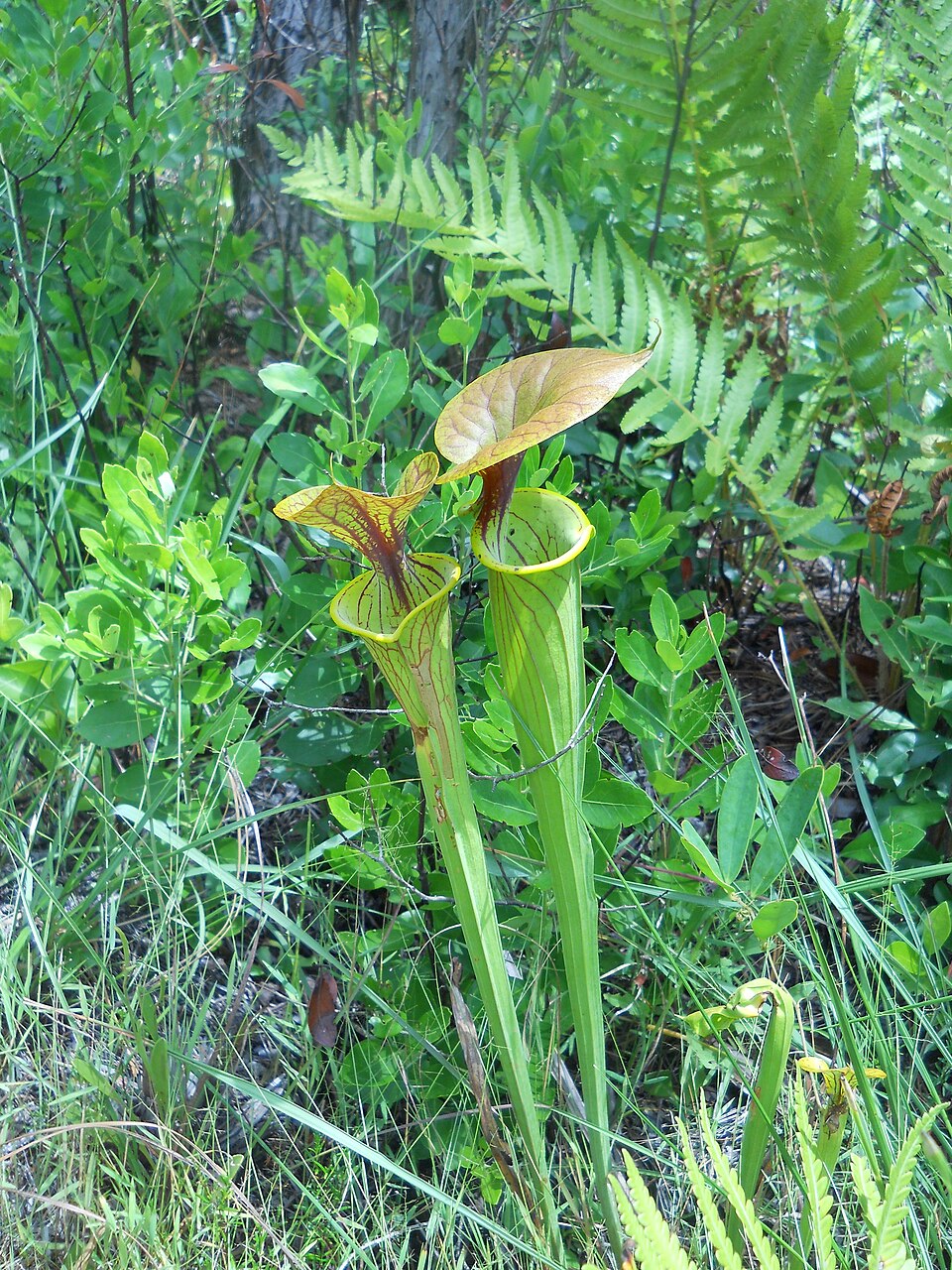
Yellow Pitcher Plant
Sarracenia flava
77 mga pananaw
Taxonomy
| Pamilya: | Sarraceniaceae |
|---|---|
| Genus: | Sarracenia |
| Umorder: | Ericales |
| Mga subspecies: | Seven varieties, including var. flava, rugelii, ornata, atropurpurea, cuprea, maxima and rubricorpora |
Pangkalahatang-ideya
Sarracenia flava is a tall, yellow trumpet pitcher plant of the southeastern United States. Its pitchers usually reach about 20 inches (50 cm) and can exceed 3 feet (1 m).
Sarracenia flava produces tall, slender, trumpet-shaped pitchers in spring. The mouth is surrounded by an outward-rolled lip, and a large lid (operculum) arches over it, keeping out excess rain. Pitchers are typically about 20 inches (50 cm) tall but can be more than a meter. The name flava is Latin for yellow.
The species is very variable in color, and seven varieties are recognized, mostly on the basis of pitcher coloration: from the all-green var. maxima to the deep red var. atropurpurea, the copper-lidded var. cuprea, the heavily veined var. ornata and var. rugelii with its large lid and red throat patch. In the field many plants show features of more than one variety.
In spring the plant produces large flowers with long, strap-like, dangling yellow petals on stalks about 20 inches (50 cm) tall. The flowers have a strong smell. Their structure, with an upside-down umbrella-shaped style, encourages insects to enter from above and leave by lifting a petal, which favors cross-pollination. In late summer and autumn the plant stops making pitchers and produces flat, sword-shaped leaves called phyllodia, which photosynthesize through the winter.
S. flava is easy to cultivate and among the most popular carnivorous plants in horticulture. It hybridizes readily; S. × catesbaei (S. flava × S. purpurea) and S. × moorei (S. flava × S. leucophylla) occur in the wild.
Heyograpikong Impormasyon
Katutubong Rehiyon: Southeastern USA: southern Alabama, Florida, Georgia, South and North Carolina, southern Virginia
Mga Climate Zone: USDA 7 and warmer; zone 6 in mulched in-ground bogs
The yellow pitcher plant ranges from southern Alabama through Florida and Georgia to the coastal plains of the Carolinas and southern Virginia, with populations also in the Piedmont and mountains of North Carolina. Like other Sarracenia it grows in acidic fens, herb bogs and seasonally wet grasslands; on the southeastern Coastal Plain these are mainly fire-maintained pine savannas, wet prairies and seepage bogs. Without frequent fire, every 1 to 3 years, shrubs and trees invade and shade the plants out. Habitat destruction is the main threat to the species.
Mga Katangiang Pisikal
Mature Size: Pitchers usually 20 in (50 cm) tall, sometimes over 3 ft (1 m)
Rate ng Paglago: Moderate
Uri ng Trap: Pitfall Trap
Bright yellow color and red, flower-like markings attract insects. Short, stiff, downward-pointing hairs on the upper pitcher guide them toward the mouth, where the rolled lip (nectar roll) is studded with nectar glands. The nectar contains coniine, an alkaloid also found in hemlock, which probably intoxicates prey. Below the lip, smooth waxy walls give no footing, and insects fall to the bottom of the tube, where digestive fluid, wetting agents and downward-pointing hairs prevent escape. Large wasps have occasionally been seen chewing their way out through the pitcher wall.
Gabay sa Pangangalaga
Mga Kinakailangang Banayad
Full sun, as much as possible. Tall trumpet Sarracenia are not suited to terraria, indoor windowsills or shade; in low light the pitchers are floppy and poorly colored. In very hot, dry areas some afternoon shade can prevent the pitchers from burning.
Full sun outdoors; natural seasonal day length araw-araw
Mga Kinakailangan sa Tubig
Uri: Distilled, reverse osmosis or rain water
Pamamaraan: Keep the pot standing in about 1.5-2.5 inches (4-6 cm) of water and never let it dry out. In an in-ground bog keep the water table about 3-7 inches (7-18 cm) below the surface.
Dalas: Check and top up the tray daily in hot weather
Humidity: Outdoor humidity is adequate
Lupa
Standard 1:1 peat:sand mix, or peat with perlite for plants outdoors that are well flushed by rain. Use a nutrient-free, acidic medium and never fertilize the soil of adult plants.
pH: Acidic (peat based)
Temperatura
Tag-init: About 71-88°F (22-31°C), as at Wilmington, NC
Taglamig: About 34-55°F (1-13°C); hardy to USDA zone 7
Pagpapakain
Dalas: Not needed outdoors; plants catch their own prey
Outdoor plants catch abundant prey. Do not pour fertilizer solution into the tall pitchers: the plant pumps it into the soil, which effectively fertilizes the soil and can lead to rhizome rot.
Pagpapalaganap
Pamamaraan: Division of the rhizome in spring, as the first pitchers or flower buds appear, with each piece keeping roots and a growing point. Seed from cross-pollinated flowers; seedlings take about 3-5 years to reach flowering size.
Kahirapan: Easy
Mga Tip sa Baguhan
Choose the sunniest outdoor spot you have, keep the pot in a tray of rain or distilled water, and leave the plant outside to go dormant over winter where your climate allows.
Pag-troubleshoot
Floppy, pale pitchers: too little light. Few pitchers after early summer: normal for S. flava, which makes most of its pitchers in one early flush. Pitchers burning in dry heat: give a little afternoon shade. Leaves dying back in autumn: normal; trim only the brown parts.
Mga Tip sa Paglaki
Do not fill pitchers with fertilizer Troubleshooting
Fertilizer solution poured into tall pitchers ends up in the soil and can cause rhizome rot. Let the plant feed itself.
Spring cleanup Seasonal
As new growth starts, trim off old brown pitcher tops that could snag the emerging flower stalks and new pitchers. Cut only dead tissue.
Sun is the whole secret General
Most failures with tall Sarracenia come from too little light, the wrong water or the wrong winter treatment. Full sun outdoors solves the first.
Mga Kawili-wiling Katotohanan
Its nectar contains coniine, the same toxic alkaloid found in poison hemlock (identified by Mody et al., 1976).
Flowers have a strong odor that can fill a room if a flowering plant is brought indoors.
In autumn it switches from pitchers to flat, non-carnivorous phyllodia, a visible sign of the cost of carnivory.
In cultivation most of the season's pitchers are produced in a single early flush.
It forms natural hybrids, including S. × catesbaei with S. purpurea.
The IUCN Red List assessed it in 2000 as Lower Risk/least concern under the older version 2.3 criteria (Schnell et al., assessment T39715A10259287).
Talambuhay
Linnaeus included S. flava in his Species Plantarum of 1753, one of only two Sarracenia species then known, alongside S. purpurea. Its carnivory, like that of the rest of the genus, was doubted for a long time: William Bartram noted in 1793 that the pitchers caught many insects but doubted the plant benefited, and the carnivorous nature of Sarracenia was only proven by Joseph H. Mellichamp in 1887. Several of the color varieties, such as var. maxima and var. ornata, carry names first used in horticulture, and Donald Schnell described var. cuprea and var. rubricorpora and, in 1998, clarified the confused naming of var. rugelii and var. maxima.
Mga Sanggunian
- Sarracenia flava, Wikipedia
- Sarracenia, Wikipedia
- About Sarracenia flava, the yellow pitcher plant, The Carnivorous Plant FAQ (Barry Rice)
- Sarracenia cultivation, The Carnivorous Plant FAQ (Barry Rice)
- Growing Sarracenia, International Carnivorous Plant Society
- Winter dormancy? Huh? What? (Wilmington, NC temperature table), The Carnivorous Plant FAQ (Barry Rice)
Magagamit para sa Pagbili
Mga Kaugnay na Uri
Manatiling Update sa Yellow Pitcher Plant
Mag-subscribe para makatanggap ng mga tip sa pangangalaga, mga gabay sa paglaki, at mga update na partikular sa Yellow Pitcher Plant at iba pang mga halamang carnivorous.